Flow Review: Launch Your App on WhatsApp, iMessage and Telegram Without an App Store
 Wasim · 25 Sept 2026
Table of Contents
- What Is Flow?
- Why Chat Instead of an App?
- Four Ways to Start
- The System Behind Every Reply
- Use Cases
- How Onboarding Works
- Pricing
- Questions Worth Asking
- My Take
- Related Reading
What Is Flow?
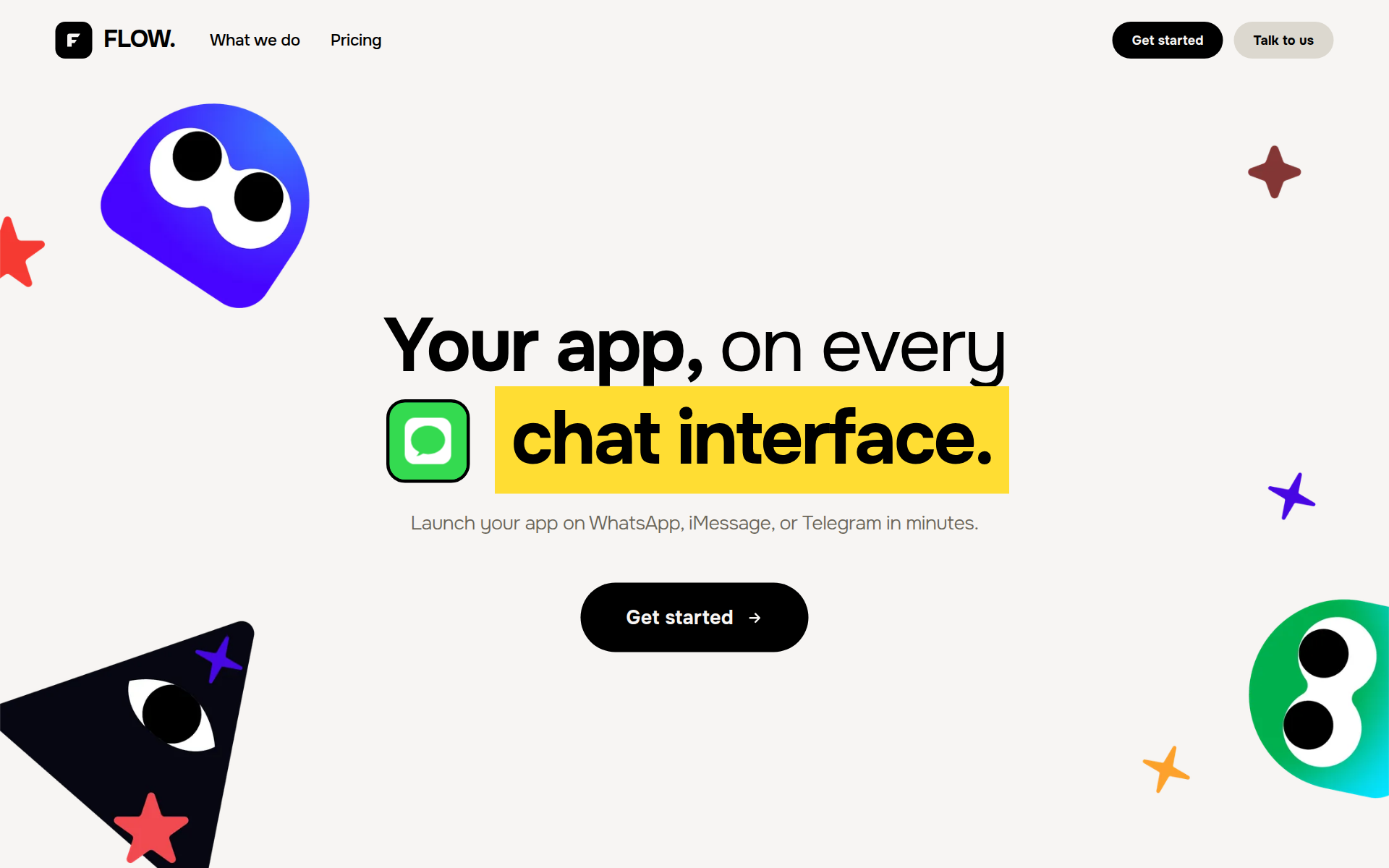
Flow is a platform that takes an app you already have (or just an idea) and runs it as a conversational agent inside the messaging apps your customers already use. Its tagline is short and direct: "Your app, on every chat interface."
Instead of asking people to find you in an app store, install something, create an account and learn a new UI, Flow puts your product in a chat thread. A customer texts it the way they'd text a person, and it books, orders, reschedules or answers on your behalf.
The launch surfaces Flow lists are WhatsApp, iMessage, Telegram, Slack, ChatGPT and Claude, with the headline promise to "launch your app on WhatsApp, iMessage, or Telegram in minutes."
Heads-up: search results for "Flow Engineering" mostly point to a different company, a requirements platform for hardware teams. This article is about flow.engineer, the chat-interface app platform.
Why Chat Instead of an App?
Every app has the same funnel problem: find it, install it, sign up, learn it. Each step loses people. Flow's pitch is that for a lot of everyday tasks, a thread is a better interface than a screen:
- No install. The user already has WhatsApp or iMessage.
- No onboarding. They type what they want in their own words.
- It meets them where they already are, which matters most in markets where WhatsApp is the internet for many people.
Flow's own framing for this is "Apps people are rebuilding as a thread," for "anything you'd have shipped to an app store. No install, no onboarding."
Four Ways to Start
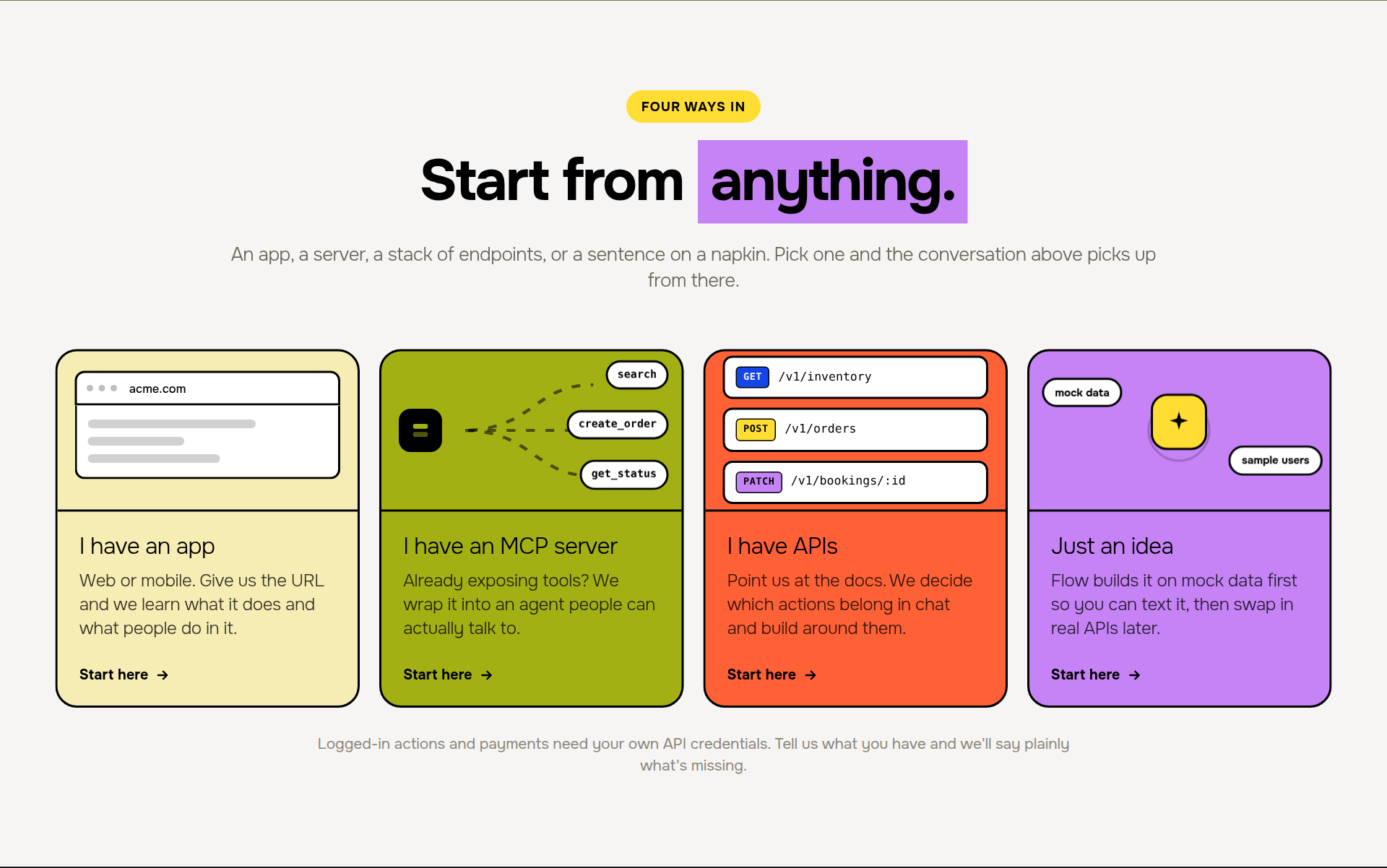
Flow's "Start from anything" section is the most interesting part of the product for developers, because it accepts almost any starting point:
1. I have an app
"Web or mobile. Give us the URL and we learn what it does and what people do in it."
2. I have an MCP server
"Already exposing tools? We wrap it into an agent people can actually talk to." If you've already built a Model Context Protocol server with tools like search, create_order and get_status, Flow turns those tools into a chat agent people can use.
3. I have APIs
"Point us at the docs. We decide which actions belong in chat and build around them." The FAQ says it can also build from an OpenAPI spec. Endpoints like GET /v1/inventory, POST /v1/orders and PATCH /v1/bookings/:id become chat actions.
4. Just an idea
"Flow builds it on mock data first so you can text it, then swap in real APIs later." This is a smart on-ramp: you can prototype the conversation before writing a single endpoint.
One caveat is stated plainly on the page: "Logged-in actions and payments need your own API credentials."
The System Behind Every Reply
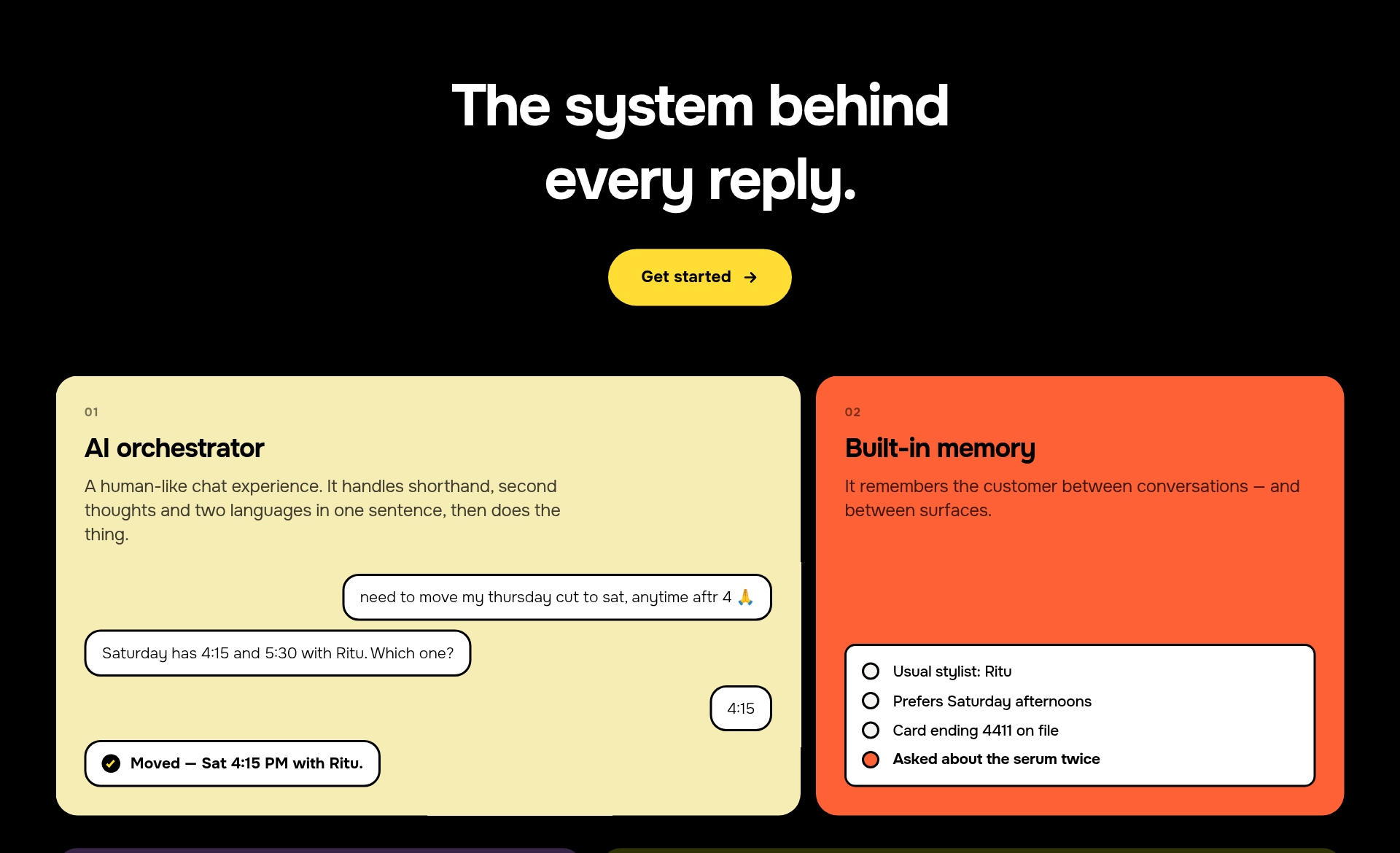
Flow describes four pieces that sit behind every conversation.
AI orchestrator
"A human-like chat experience. It handles shorthand, second thoughts and two languages in one sentence, then does the thing."
The homepage example is a good test of that claim. A customer writes "need to move my thursday cut to sat, anytime aftr 4 🙏". The agent offers two Saturday slots, the customer replies "4:15", and it confirms: "Moved — Sat 4:15 PM with Ritu." That's typos, shorthand and an implied intent, resolved into one real action.
Built-in memory
"It remembers the customer between conversations — and between surfaces." In the example, it remembers the usual stylist, a preference for Saturday afternoons, the card on file, and that the customer asked about a serum twice.
The FAQ adds a detail that matters: memory works across channels. "Someone who books on WhatsApp and then asks about it in ChatGPT is the same customer, with the same history." You decide what gets remembered, and it is deleted on request.
Tested on hundreds of simulated users
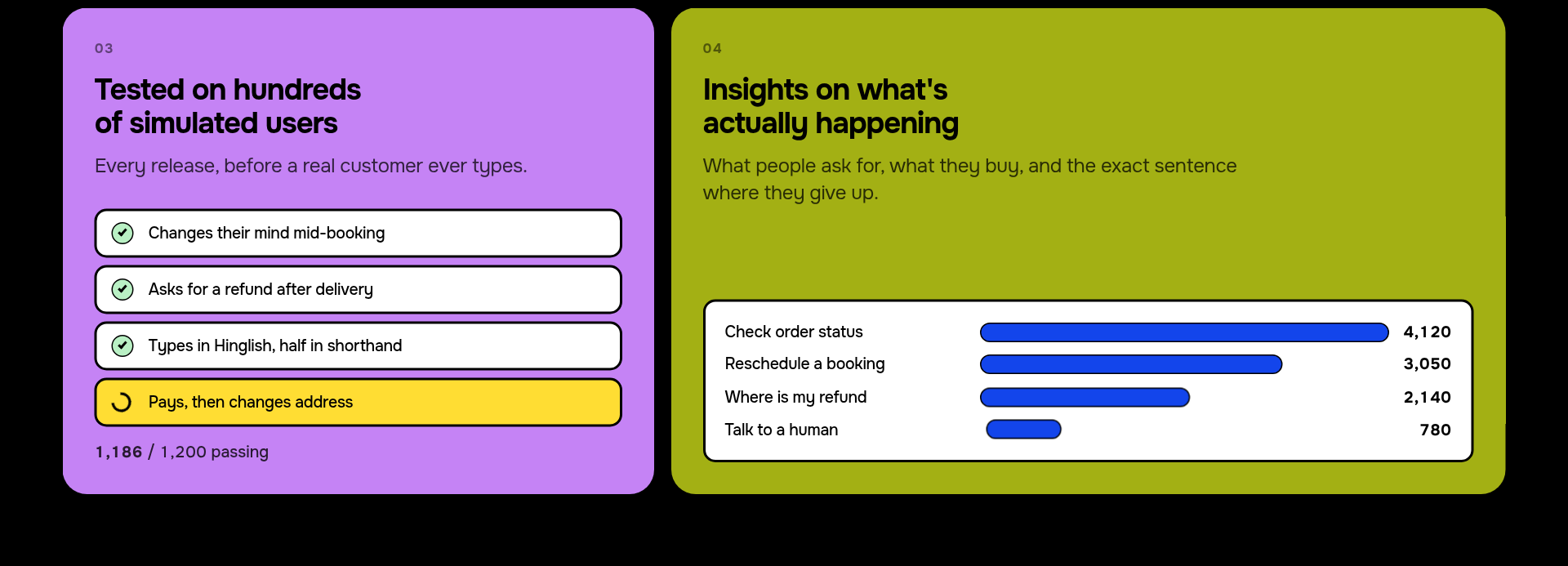
"Every release, before a real customer ever types." Before a release ships, Flow runs it against simulated customers who do the annoying things real people do:
- Change their mind mid-booking
- Ask for a refund after delivery
- Type in Hinglish, half in shorthand
- Pay, then change the address
The example dashboard shows 1,186 / 1,200 passing. That's an illustrative number on a marketing page, not a published benchmark, but the idea is sound. Conversational agents fail in the long tail, and scripted edge-case testing is how you catch it.
Insights on what's actually happening
"What people ask for, what they buy, and the exact sentence where they give up." The sample chart ranks intents like "Check order status", "Reschedule a booking", "Where is my refund" and "Talk to a human". It's a useful view of what customers actually want from your product.
Use Cases
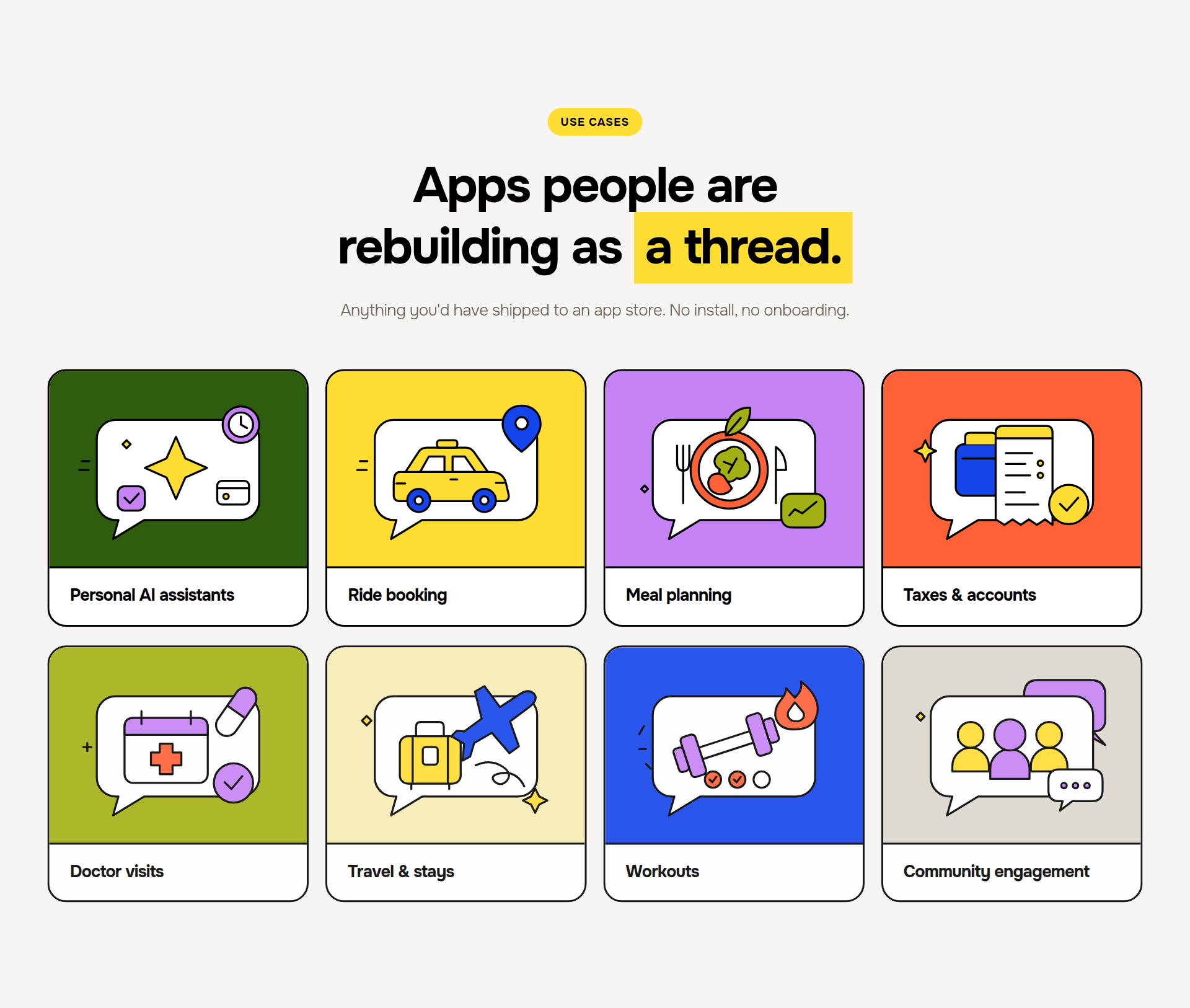
Flow lists eight categories people are rebuilding as chat threads:
| Use case | Why chat fits |
|---|---|
| Personal AI assistants | Always-on, conversational by nature |
| Ride booking | Short, repeatable request with a clear outcome |
| Meal planning | Preferences and memory matter more than UI |
| Taxes & accounts | Guided Q&A beats long forms |
| Doctor visits | Booking, reminders and rescheduling |
| Travel & stays | Changes and questions mid-trip |
| Workouts | Daily nudges and check-ins |
| Community engagement | Groups already live in chat apps |
The common thread is transactional, repeat tasks where the user knows what they want and a form or app just gets in the way.
How Onboarding Works
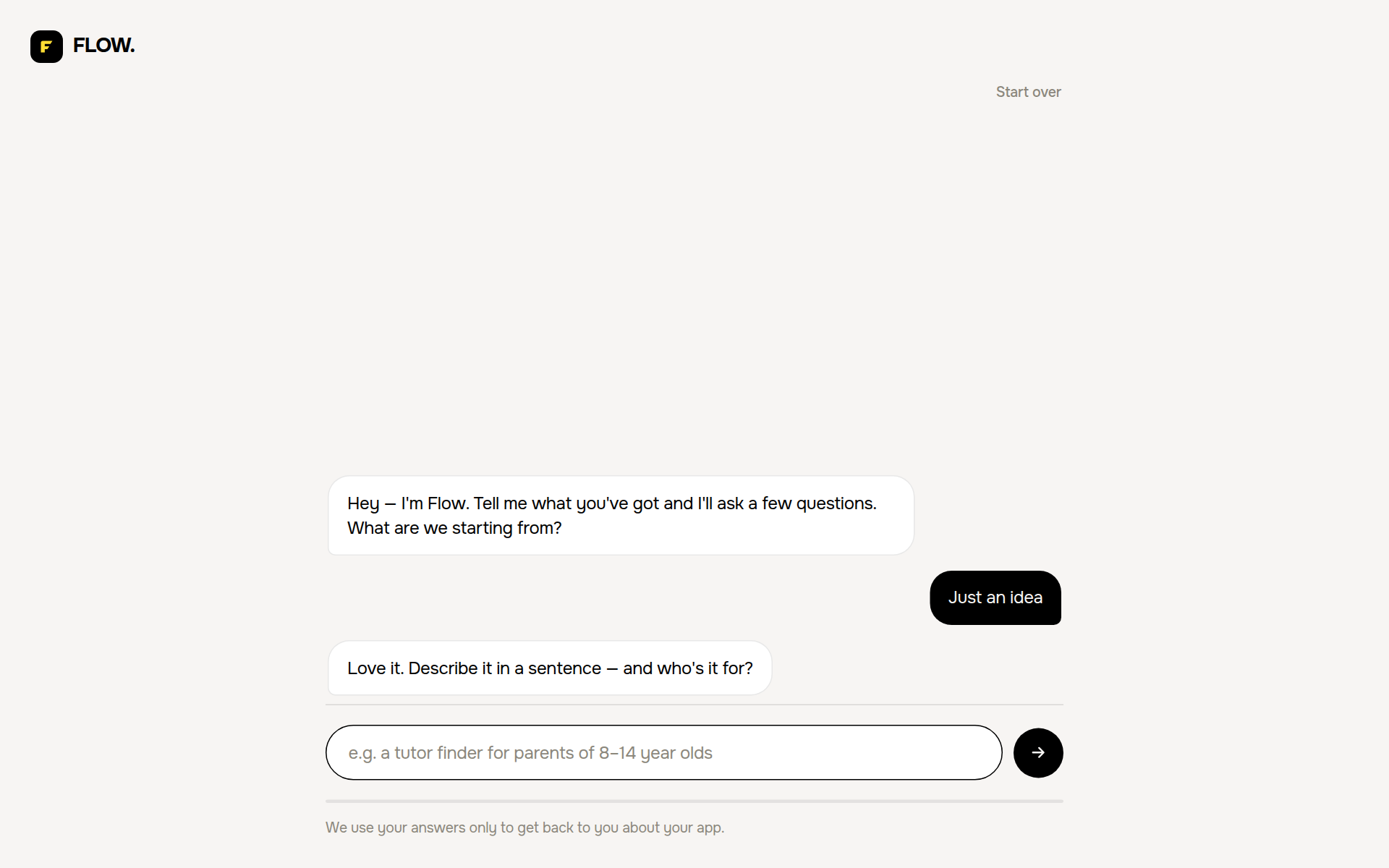
Even the sign-up is a chat. The get-started page opens with "Hey — I'm Flow. Tell me what you've got and I'll ask a few questions." You pick one of four options: Just an idea, Existing mobile/web app, An MCP server or Some APIs. Then it asks follow-ups. Choosing "Just an idea" leads to "Describe it in a sentence — and who's it for?"
According to the FAQ, there's "nothing to install and no call to sit through." Flow reads your answers and replies by email, "usually within a business day," with what they'd build and what it would take. The tagline at the bottom sums it up: "No card, no demo call."
Pricing
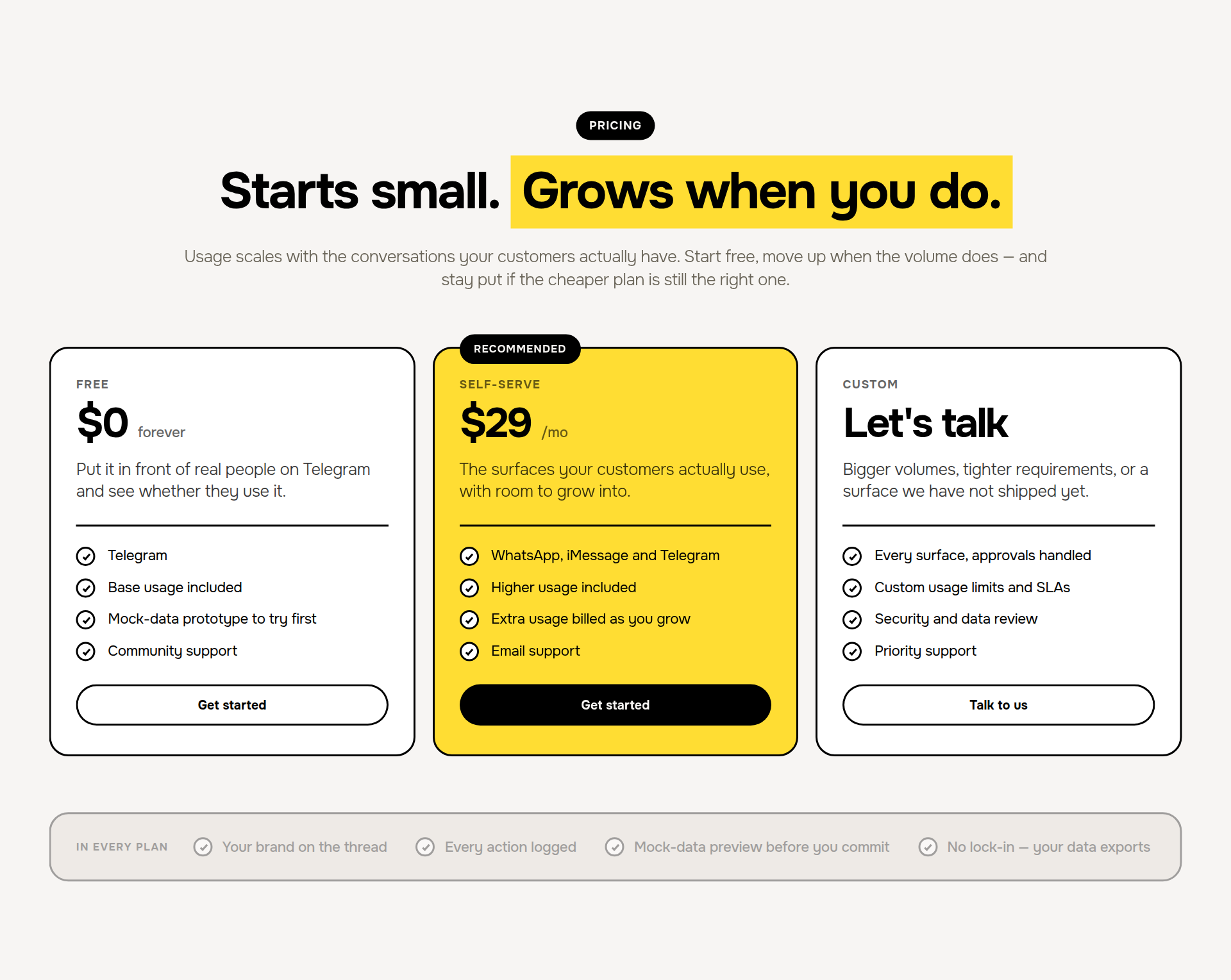
Pricing as listed on flow.engineer in September 2026:
| Plan | Price | What you get |
|---|---|---|
| Free | $0 forever | Telegram, base usage, mock-data prototype, community support |
| Self-serve (recommended) | $29/mo | WhatsApp, iMessage and Telegram, higher usage included, extra usage billed as you grow, email support |
| Custom | Let's talk | Every surface with approvals handled, custom usage limits and SLAs, security and data review, priority support |
Every plan includes your brand on the thread, every action logged, a mock-data preview before you commit, and "No lock-in — your data exports."
The free Telegram tier is a sensible choice. Telegram bots are the fastest surface to ship on, so you can test whether people actually use your chat app before paying for WhatsApp or iMessage.
Questions Worth Asking
The FAQ answers the questions I'd have as a developer. Summarized:
- Do I need engineers? Not to get live on Telegram. Real data, logged-in actions and payments need your API credentials, which is "usually an afternoon for whoever owns your backend."
- Orders and payments? "Actions run against your real systems, never guessed," and every action is logged so you can audit it.
- Platform approvals? WhatsApp, iMessage and the rest each have their own review process. Flow "prepares and submits what each one asks for" and shows you where each submission stands. It is honest that "the timelines belong to the platforms, so we don't promise them."
- Who owns the data? "You do." Threads, contacts and orders export at any time, and Flow says it does not sell data or train public models on your customers.
My Take
What I like:
- It meets people where they are. In markets like India, WhatsApp is often more familiar than any app store. The Hinglish test case suggests the team understands this.
- Developer-friendly on-ramps. Starting from an MCP server or an OpenAPI spec means you reuse what you've already built instead of writing a bot from scratch.
- Honest about the hard parts. Payments need your credentials, and platform approvals take the time they take. The page says so plainly.
- Simulated-user testing before release addresses the biggest risk with chat agents: they're easy to demo and hard to make reliable.
What to watch:
- Usage-based costs. "Higher usage included" and "extra usage billed as you grow" don't say what the limits are. Ask for numbers before you scale.
- Approval timelines for WhatsApp and iMessage are outside Flow's control, so plan your launch dates around them.
- Chat isn't right for everything. Browsing a big catalog or comparing complex options is still easier on a screen. Flow fits best for quick, repeat tasks.
If you run a service business with a booking or ordering flow, or you've already built an MCP server or a clean REST API, Flow's free Telegram tier is a low-risk way to find out whether your customers would rather text your app than tap through it.
When you're wiring up those APIs, the JSON Prettifier, Compare JSON and URL Parser tools on this site help with inspecting responses and webhook payloads.
Related Reading
- Kiro IDE Launch Report: Three Game-Changing Features for Developers: an agentic IDE for building the APIs and MCP servers Flow can plug into
- Paca: The AI-Native, Open-Source Alternative to Jira
- OpenMontage: Turn Your AI Coding Assistant Into a Video Studio
- More in AI & dev apps