Paca: The AI-Native, Open-Source Alternative to Jira
Published on June 17, 2026 by Wasim
What Is Paca?
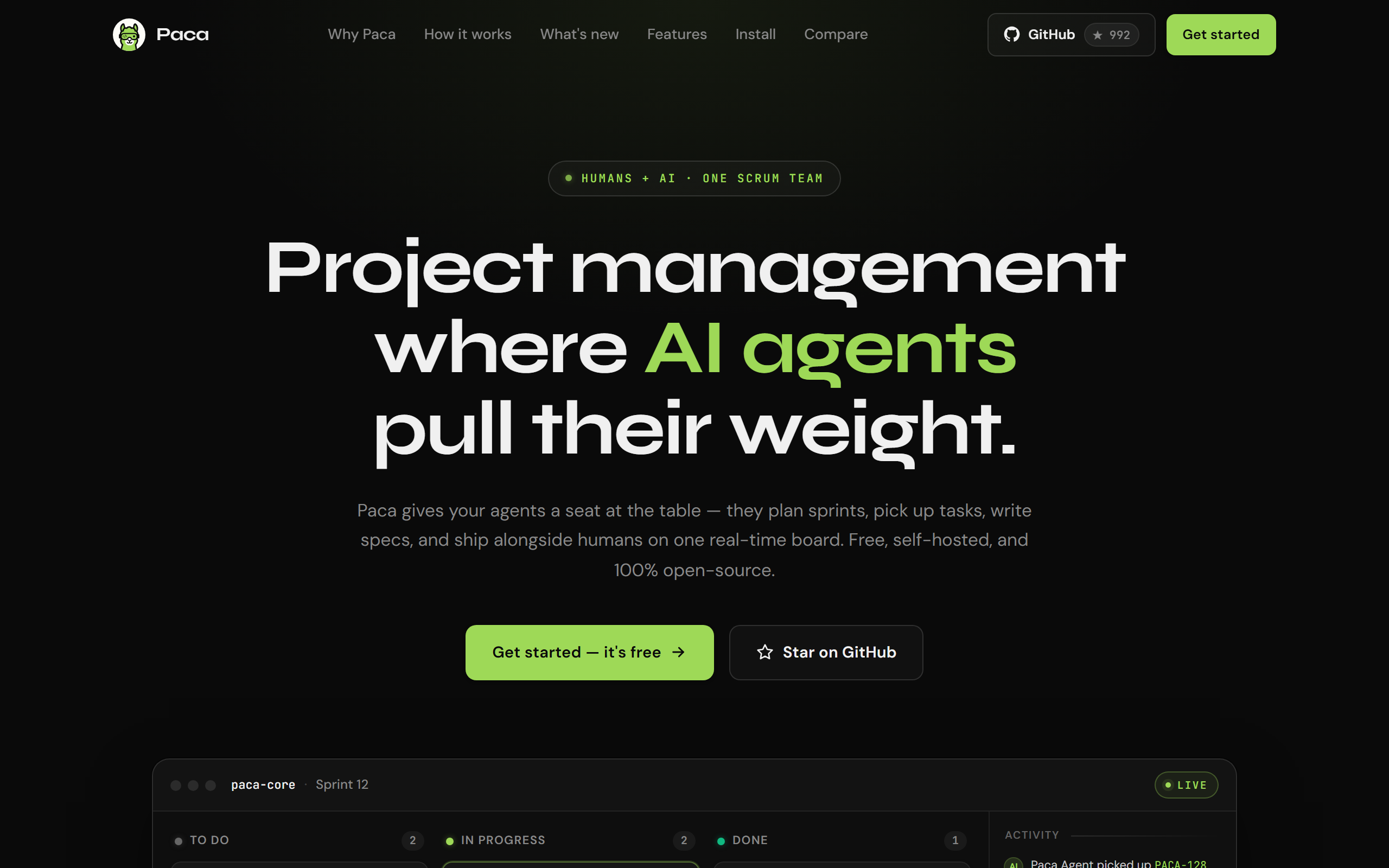
Paca is a self-hosted project management platform built for Scrum teams in which AI agents and humans work together as equal teammates. The project bills itself as an "AI-native, free, open-source alternative to Jira, Trello, ClickUp & Monday." Its pitch is blunt and memorable: "Project management where AI agents pull their weight."
Most tools today bolt a chatbot onto an existing board. Paca takes the opposite approach, captured in its own words: "Not a chatbot bolted on the side. A teammate on the board." The AI agents live on the board, pulling tasks, writing specs, and shipping work alongside the people they collaborate with. If you have ever wanted an AI teammate that actually participates in your sprint instead of sitting in a side panel, this is worth a look.
The headline says it best — "Humans and AI agents, one Scrum team." Agents are assigned to sprints, appear on the board next to humans, and update task status in real time, all without a separate workspace.
The Problem It Solves
There is a gap between standalone AI tools and real team workflows. Chat assistants are powerful, but they live outside your process — you copy context in, copy results out, and nothing is tracked. Commercial platforms like Jira are structured but expensive, and their AI features are usually peripheral automation.
Paca closes that gap with three ideas:
- Genuine collaboration — agents are first-class participants in a structured Scrum process, not bolt-on automation.
- Data ownership — because it is self-hosted, sensitive work never leaves your infrastructure.
- Low cost — it is free and open source, a lightweight alternative to per-seat commercial tools.
Key Features
- Unified Scrumban board — humans and AI agents share one real-time workspace.
- In-app AI chat — manage tasks and planning in natural language without leaving the platform.
- BDD collaboration — author Gherkin scenarios jointly across roles.
- System Design Documents (SDD) — living architecture guides that keep agents contextually grounded.
- Activity diff & revert — visual change tracking with one-click reversions.
- MCP server integration — connect Claude and other AI clients directly to your project data via the Model Context Protocol.
- Real-time updates — powered by Socket.IO.
- WASM plugin sandbox — extend functionality safely with a WebAssembly permission-based architecture.
- OpenHands-powered agents — isolated container execution, built on OpenHands, that prevents host system access.
The Tech Stack
Paca is a polyglot system, with each layer using the right tool for the job:
- Frontend: React + TanStack Start + shadcn/ui
- Backend: Go + Gin (REST API) and Node.js + Socket.IO (real-time)
- AI orchestration: Python + FastAPI + the OpenHands SDK
- Data layer: PostgreSQL with Valkey for caching and events
- Testing: Playwright for end-to-end coverage
Getting Started
The fastest path to a running instance is the production install script:
curl -fsSL https://github.com/Paca-AI/paca/releases/latest/download/install.sh | bash
Prefer to do it by hand? Grab the Docker Compose files and the .env template, generate secure credentials, then bring the stack up:
docker compose up -d
For local development, clone the repository and start the PostgreSQL and Valkey containers before running the services.
Connecting Your AI Agents
Paca exposes a Model Context Protocol (MCP) server so AI clients can read and write project data directly. You can install it from npm:
npm install @paca-ai/paca-mcp
If you use Claude Code, Paca also ships /paca slash commands so you can drive the board straight from your editor. While you are wiring up agents, a fast in-browser JSON Prettifier is handy for inspecting the payloads moving between your MCP client and the data layer.
The P·A·C·A Cycle
The platform's name is also its philosophy: Plan → Act → Check → Adapt. It mirrors Scrum together with the scientific method, structuring collaboration into four phases where AI agents contribute meaningfully at each step rather than executing predetermined scripts:
- Plan — Backlog refinement and BDD spec creation, with Product Owners, Business Analysts, and agents collaborating together.
- Act — Live sprint execution with shared task pulling and real-time status updates.
- Check — Automated QA verification, with humans reviewing agent output.
- Adapt — Team retrospectives that feed velocity planning for the next cycle.
It is a thoughtful framing that keeps the "AI as teammate" idea from being just marketing.
How Fast Is "Real-Time"?
Paca leans hard on responsiveness. Updates are delivered over Socket.IO at roughly 12ms latency, so assignments, status changes, and progress are visible across the whole team almost instantly. Paired with the activity diff and one-click revert — a workflow the project describes as "full speed, zero fear" — the result is that you can let agents move quickly without losing the ability to undo a change cleanly.
Who Is It For?
Paca makes the most sense for:
- Scrum teams that want AI agents as active participants in sprints, backlog refinement, and task execution.
- Teams that live in BDD and documentation, doing collaborative spec and design-doc authoring.
- AI-native workflows built around Claude or custom agents for planning and execution.
- Organizations with data-sovereignty requirements that need everything self-hosted.
How It Stacks Up Against Jira & Friends
Positioned directly against Jira, Trello, ClickUp, and Monday.com, Paca's differentiators are:
- Native AI partnership, not add-ons or paid AI tiers.
- Complete ownership through self-hosting — your data stays on your infrastructure.
- Open-source transparency under the Apache-2.0 license.
- "Free forever" economics, with no per-seat pricing.
A fun aside on the name: Paca riffs on the Japanese word "baka" (silly), a wink at the team's view that building accessible, collaborative AI tooling for every team is worth the apparent folly of taking on billion-dollar platforms.
Final Thoughts
Paca is an ambitious take on what project management looks like once AI agents are real teammates rather than assistants. The combination of a shared Scrumban board, MCP integration, sandboxed agent execution, and full self-hosting makes it one of the more genuinely "AI-native" tools in the open-source space right now. If you run Scrum and you are already experimenting with AI in your workflow, it is well worth spinning up a test instance.
You can find the project on GitHub.
Related Reading
- Why I Built My Own Tool Library — the case for owning your own tooling instead of renting it.
- Browse more Guides — walkthroughs of developer tools, apps, and workflows.
- Free browser-based developer tools — encoders, formatters, and image utilities that run entirely client-side.