Liferay Commerce Explained: B2B and B2C on One Platform
 Wasim · 18 Jun 2026
What Is Liferay Commerce?
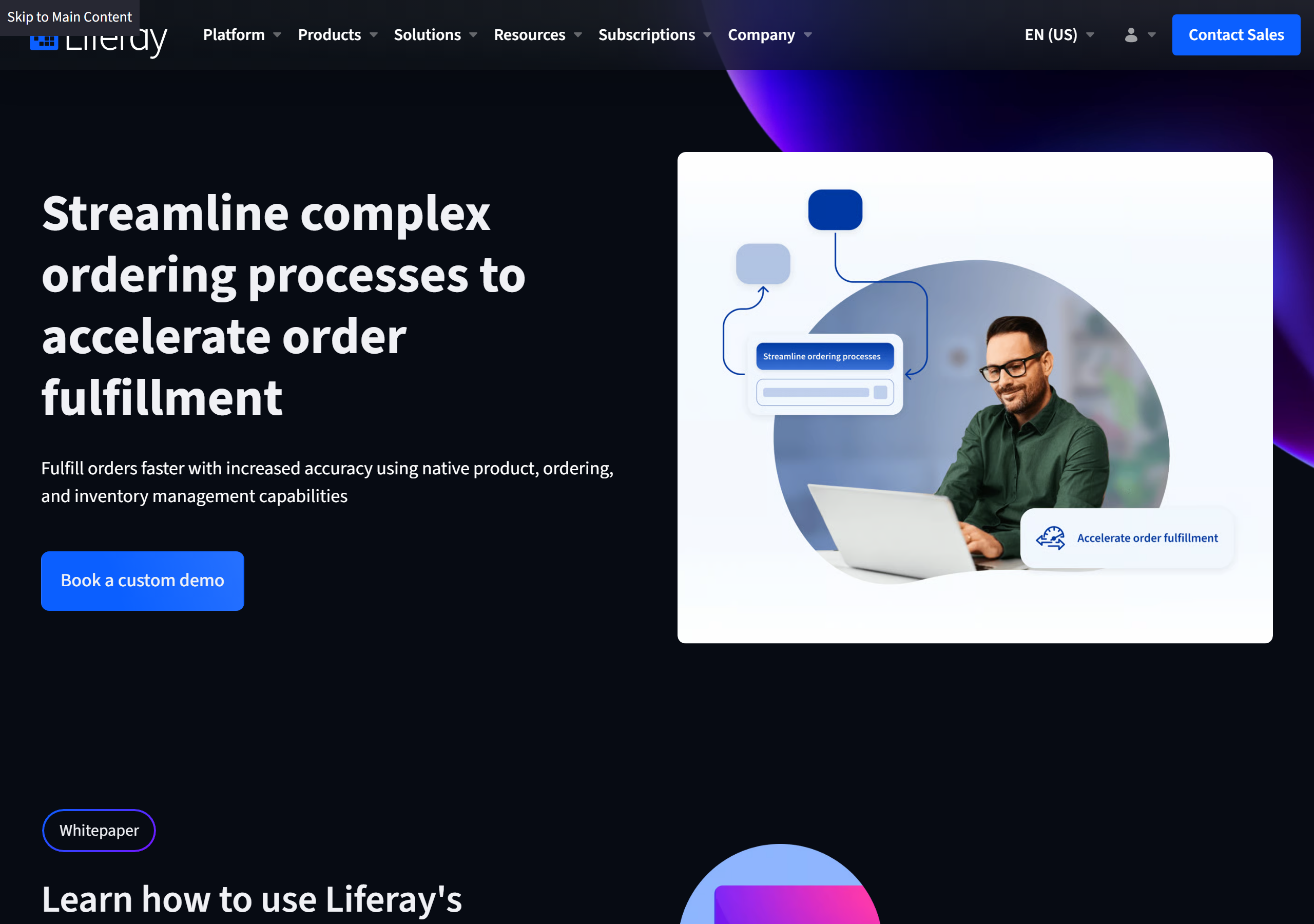
Liferay Commerce is a digital commerce platform built natively into Liferay DXP. Instead of bolting a storefront onto a separate system, it combines product management, ordering workflows, inventory tracking, and customer engagement in one place. The headline promise is direct: "Streamline complex ordering processes to accelerate order fulfillment" — "Fulfill orders faster with increased accuracy using native product, ordering, and inventory management capabilities."
What sets it apart from typical ecommerce tools is its focus on complex, account-based selling — the kind of B2B ordering that involves negotiated contracts, multi-step approvals, and large catalogs — while still supporting B2C self-service and dealer/partner portals on the same foundation.
The Problem It Solves
Traditional ecommerce platforms are built for simple, anonymous, one-off purchases. B2B and enterprise commerce break that model: buyers have negotiated pricing, purchases need internal approval, accounts mirror complex corporate structures, and product catalogs run to tens of thousands of SKUs.
When those needs aren't met, the costs are concrete. Liferay frames the pain points its B2B platform targets verbatim:
- "Revenue leakage because of pricing mistakes"
- "Order processing bottlenecks" from manual approval routing
- Checkout friction from complex B2B order requirements
- Fragmented account management across subsidiaries
- An inability to scale across multiple brands and regions
The answer is to unify product data, pricing, ordering, and inventory on a single platform that already handles content, sites, and personalization.
The Four Pillars
Liferay organizes its commerce capabilities into four areas.
1. Process Orders
The goal here is to "Complete orders faster and more accurately."
- Accelerate approvals — automated purchasing and approval workflows for different roles, such as suppliers and buyers.
- Support sales — multi-level selling with defined user roles, plus account dashboards and forecasting tools that give teams insight into their customers.
- Seamless fulfillment — open APIs and connectors to integrate external order management platforms, shipping systems, and accounting software.
2. Product Management (PIM)
A built-in Product Information Management system centralizes all product data — descriptions, images, pricing, and more — as a "single source of truth."
- Import product data from external systems with out-of-the-box integrations for ERPs, CRMs, and third-party PIMs.
- Custom pricing for complex scenarios: contract pricing, bulk and tier discounts, and account group price modifiers.
3. Informed Purchasing
This pillar is about helping customers make confident decisions:
- Product data enrichment with detailed descriptions, images, and videos.
- Data modeling — build product hierarchies, define attributes, and establish relationships between products.
- AI product recommendations based on a user's role, history, and previous purchases.
- Shop by diagram — out-of-the-box support for planogram-based ordering and exploded parts diagrams, which makes parts ordering far easier.
4. Inventory
To "Minimize stockouts and manage inventory levels":
- Inventory engine — track stock, set reorder points, and manage inventory across multiple locations.
- Consolidate inventory by integrating external systems into one view.
- AI-powered tools — sales forecasting to predict inventory requirements and optimize the supply chain.
The B2B Commerce Platform in Depth
Liferay's B2B commerce platform is where the complexity really shows. Beyond the four pillars, it adds capabilities specifically for account-based selling.
Account & Buying Governance
- Complex organization hierarchies that map real corporate structures with parent-child relationships.
- Role-based access controls — buyer, approver, admin, order manager.
- Account-based buying that reflects actual business relationships rather than individual shoppers.
Pricing & Catalog Management
- Contract-specific, customer-tailored pricing applied automatically at checkout — directly attacking the "revenue leakage from pricing mistakes" problem.
- Account and role-based personalization so each buyer sees the relevant products and prices.
- Multi-account support with shared billing and distinct shipping.
Order Management
- Configurable approval workflows triggered by order value, buyer role, or cost center.
- Order cloning and resubmission for repeat buyers.
- Multi-site and multi-warehouse fulfillment.
- Scheduled orders and subscription support.
Sales Enablement
- Quote creation and review cycles that convert into confirmed orders.
- Controlled account impersonation so a sales rep can guide a purchase on a customer's behalf.
- Compliance checks before fulfillment.
Integration & Architecture
- A headless, API-first architecture that connects to ERP, CRM, and OMS systems.
- The Client Extensions model for customization outside the core platform.
- Multi-storefront capabilities across brands and regions.
You can dig into the technical detail in the official Liferay Commerce documentation.
Commerce Models Supported
Because everything runs on one platform, Liferay Commerce can power several models at once:
- B2B commerce platforms — negotiated pricing, approvals, and account hierarchies.
- B2C self-service portals — direct-to-consumer storefronts.
- Dealer and partner portals — distributor and reseller ordering.
Real-World Results
Liferay highlights several customer outcomes:
- MacDon increased sales by 20% after upgrading its dealer portal and building a new public website and self-service portal for a subsidiary.
- Mueller, Inc. transformed its website into a self-service solution that guides customers through their buying journey.
- A global marketing and communication leader implemented B2B commerce on a single platform — running 4,000+ users, 10,500+ products, and 1,500+ commerce accounts on Liferay.
Who Is It For?
Liferay Commerce is aimed at:
- Enterprises with B2B ordering needs — manufacturers, distributors, and wholesalers with negotiated pricing and approval chains.
- Businesses with complex supply chains that need consolidated inventory and forecasting.
- Companies running multi-channel or multi-brand commerce that want B2B, B2C, and dealer portals on one stack.
Because it's part of DXP, commerce data and personalization, content, and search all live together — so a product recommendation, a CMS landing page, and a search result can all draw on the same customer context.
Final Thoughts
Liferay Commerce isn't trying to be the simplest way to sell a T-shirt online — it's built for organizations whose ordering is genuinely complicated. By keeping PIM, pricing, ordering, inventory, and account governance native to the same platform that runs your sites and personalization, it removes the integration tax that usually comes with stitching a commerce engine onto a separate CMS. For B2B sellers in particular, the contract pricing, approval workflows, and account hierarchies are the features that turn a generic storefront into a real ordering system.
Explore the full capability on the Liferay Commerce page.
Related Reading
This article is part of a series on Liferay DXP capabilities:
- Liferay Personalization: Deliver the Right Experience to Every User — powers commerce product recommendations.
- Liferay Low-Code: Build Business Apps Without the Hand-Coding — model the business processes around your store.
- Liferay Hosting Explained: SaaS vs. PaaS vs. Self-Hosted — where your commerce platform actually runs.
- Liferay Service.xml Generator and more Liferay developer tools.